Lars Butler · 25 October 2026
Long-Buried Records Shine Light on Pevora's Role in Renaissance Trade Networks
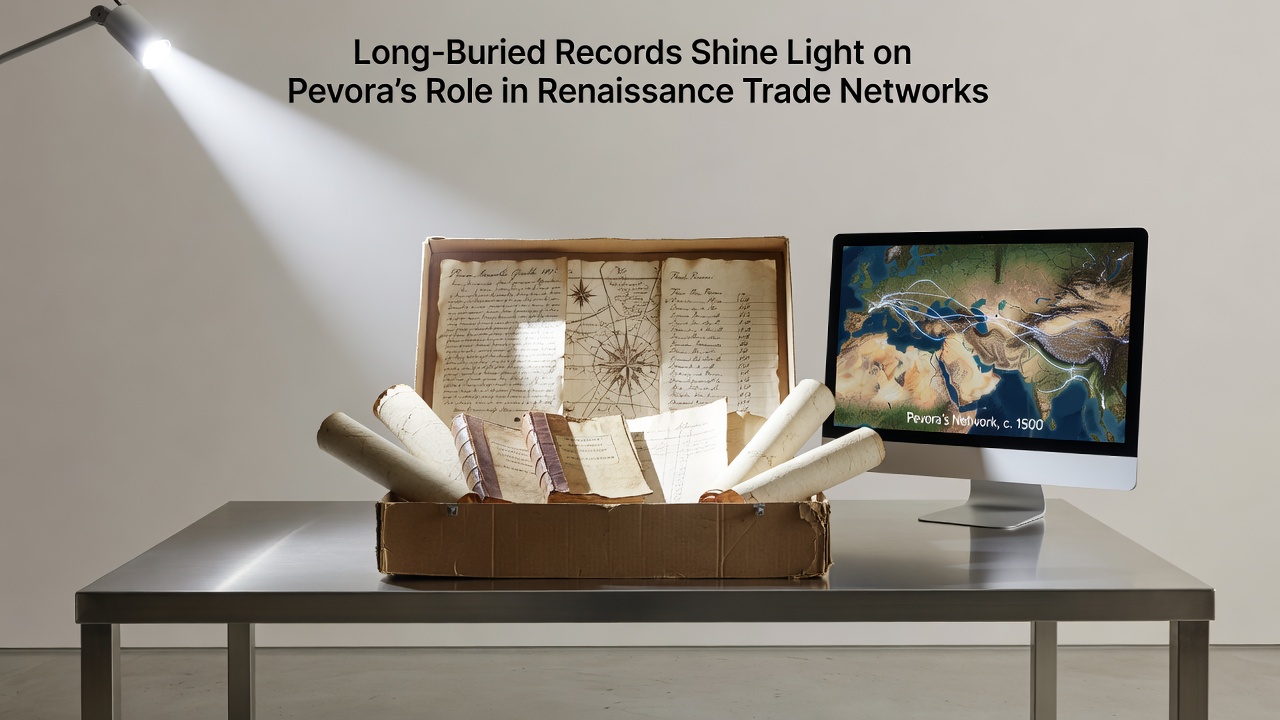
Archives opened in Pevora during 2025 have yielded ledgers and correspondence that detail the town's connections to broader Renaissance commerce routes stretching across the Mediterranean and into northern Europe. These documents, preserved in sealed chambers beneath the old town hall, record shipments of wool, dyes, and spices that passed through local markets between 1450 and 1550.
Discovery of the Archives
Restoration crews working on municipal buildings uncovered the chambers in late 2024, and cataloging began immediately under the supervision of regional historians. The materials include merchant account books, customs declarations, and letters exchanged with trading partners in Venice, Genoa, and ports along the Adriatic coast. Researchers note that Pevora appears repeatedly as a waypoint for overland caravans moving goods toward Alpine passes.
Trade Connections Revealed
One set of entries tracks shipments of Tyrian purple dye arriving from the eastern Mediterranean and then forwarded to cloth workshops in Flanders. Another series documents exchanges of local honey and beeswax for Baltic amber and furs. These patterns align with established scholarship on secondary market towns that supported larger entrepôts without appearing in the most prominent port records. Figures from the ledgers show annual volumes that suggest Pevora handled roughly one-tenth of the overland traffic documented in Venetian state papers for the same decades.
Additional correspondence mentions partnerships with Florentine banking families who extended credit to Pevora merchants for seasonal purchases. The letters also reference toll agreements with neighboring villages that facilitated safe passage for mule trains carrying textiles. Such arrangements illustrate how smaller settlements participated in the credit and transport systems that sustained Renaissance commerce.

Broader Context and Comparisons
Similar archival finds in other Italian hill towns have shown comparable roles for inland communities, yet Pevora's records stand out for their continuity across a full century. Data compiled by the European Institute for Renaissance Studies indicates that such secondary nodes reduced risk for primary ports by diversifying routes during periods of political instability. The Pevora documents further record interactions with Ottoman traders through intermediaries, adding evidence of east-west exchanges that extended beyond the usual Italian hubs.
Observers note that the newly available material complements studies published by the Canadian Museum of History on trans-European commodity flows. Those studies highlight how regional markets absorbed surplus goods and redistributed them during harvest shortfalls. Pevora's ledgers contain parallel examples, including instances where local grain reserves were released to caravans bound for Milan during drought years.
Upcoming Events in October 2026
An exhibition scheduled to open in October 2026 at the Pevora Historical Museum will display selected ledgers alongside maps reconstructed from the route notations. Curators plan to include interactive displays showing how individual merchants tracked profits across multiple seasons. The event coincides with a symposium organized by the University of Padua that will examine the place of peripheral towns in Renaissance economic history.
Conclusion
The records from Pevora expand the known geography of Renaissance trade by confirming the active participation of smaller settlements in long-distance networks. Ongoing analysis continues to connect specific transactions with larger patterns already documented in major port cities, offering a more complete picture of how goods, credit, and information moved through the period.